Missed call callbacks: no caller forgotten
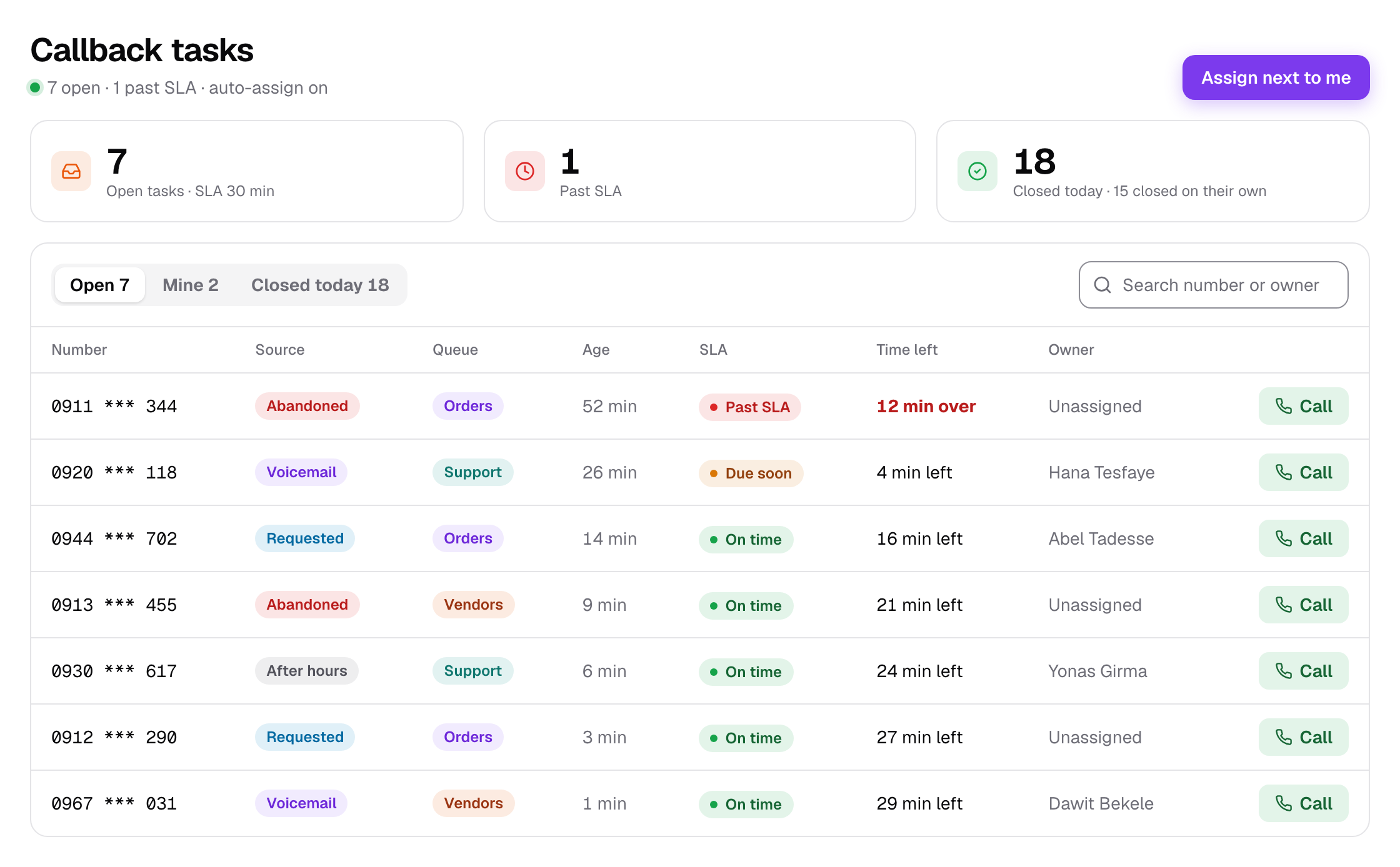
A caller who hangs up in the queue still needs an answer,. With Halo's missed call callbacks, every hang-up, voicemail and callback request becomes a task on a shared list, so someone calls the customer back.
Missed call callbacks
What you get
Halo turns missed calls into work that someone owns. Each task stays on the shared callback list until the customer is reached, and supervisors hear about it when the queue is short of agents.
Hang-ups become tasks
Callers who hang up while waiting in a queue become callback tasks on their own. Nobody has to copy numbers from a call log.
Voicemails and callback requests too
Voicemails and callback requests from the voice menu or a queue land on the same list as hang-ups, so there is one place to work from.
After-hours calls, if you want them
Switch it on, and calls that come in after hours also become callback tasks for the morning team.
Tasks close themselves
When the customer is reached, the task closes itself. Agents do not have to tick it off, and the list shows only the callers still waiting.
A shared list with auto-assign
Everyone works from one shared list. Turn on auto-assign to hand tasks to agents, and use SLA tracking to keep an eye on deadlines.
An alert when too few agents are ready
Supervisors get an alert when fewer than 2 agents are ready in a queue for 5 minutes in open hours, and a critical alert when no agent is logged in.
How it works on a busy day
At 12:15 the “Orders” queue is busy. Abel Tadesse, calling from 0912 *** 871, waits for two minutes and hangs up. Halo puts a callback task for his number on the shared list. A few minutes later another customer leaves a voicemail, and that becomes a task too.
Auto-assign gives both tasks to Samuel Kebede. He calls Abel at 12:40 and reaches him. Halo sees that the customer was reached and closes the task on its own. The voicemail task closes the same way at 12:52.
At 13:00 two agents go on their lunch break and only one agent is ready in “Orders”. After 5 minutes, Hana Tesfaye, the supervisor, gets an alert and asks one agent to come back early.
Facts
| What becomes a task | Queue hang-ups, voicemails, callback requests from the voice menu or queue |
|---|---|
| After-hours calls | Become tasks if you switch it on |
| Closing a task | Closes itself when the customer is reached |
| Assignment | Shared list, with optional auto-assign |
| Deadlines | SLA tracking on the shared list |
| Too few agents | Alert when fewer than 2 are ready for 5 minutes in open hours |
| No agents | Critical alert when no agent is logged in |
Questions about missed call callbacks
Which missed calls become callback tasks?
Callers who hang up while waiting in a queue, voicemails, and callback requests from the voice menu or a queue all become callback tasks. If you switch it on, calls that arrive after hours become tasks as well. They all go to the same shared list.
How does a callback task get closed?
A task closes itself when the customer is reached. Agents do not need to mark it done by hand, so the open tasks are the callers still waiting for a call back.
Can tasks go to agents automatically?
Yes. Auto-assign is optional. With it on, Halo hands tasks to agents. With it off, agents pick tasks from the shared list themselves. The shared list has SLA tracking either way.
How do supervisors know when too few agents are ready?
Halo sends an alert when fewer than 2 agents are ready in a queue for 5 minutes in open hours, and a critical alert when no agent is logged in. Alerts go to Telegram, with acknowledge and mute buttons. See automatic calls and alerts.
How do callers ask for a callback?
Queues can offer a callback when the wait gets long, and the voice menu has a callback offer step. Either way the request becomes a task on the shared list. See how call queues keep callers informed while they wait.
Related features
Where this matters most: Delivery and logistics. See how Halo is priced on the pricing page.