Call center software for banks and microfinance in Ethiopia
Banks and microfinance institutions want every call answered and the call data kept close. Halo is call center software for banks that runs on a server for your institution alone, records agent calls and logs every time a recording is played.
Banks and microfinance
Three call problems banks know
You want call data kept in the country
Customers talk about their accounts on the phone. You want those calls, recordings and call history kept in Ethiopia, under your own control.
Calls recorded and auditable
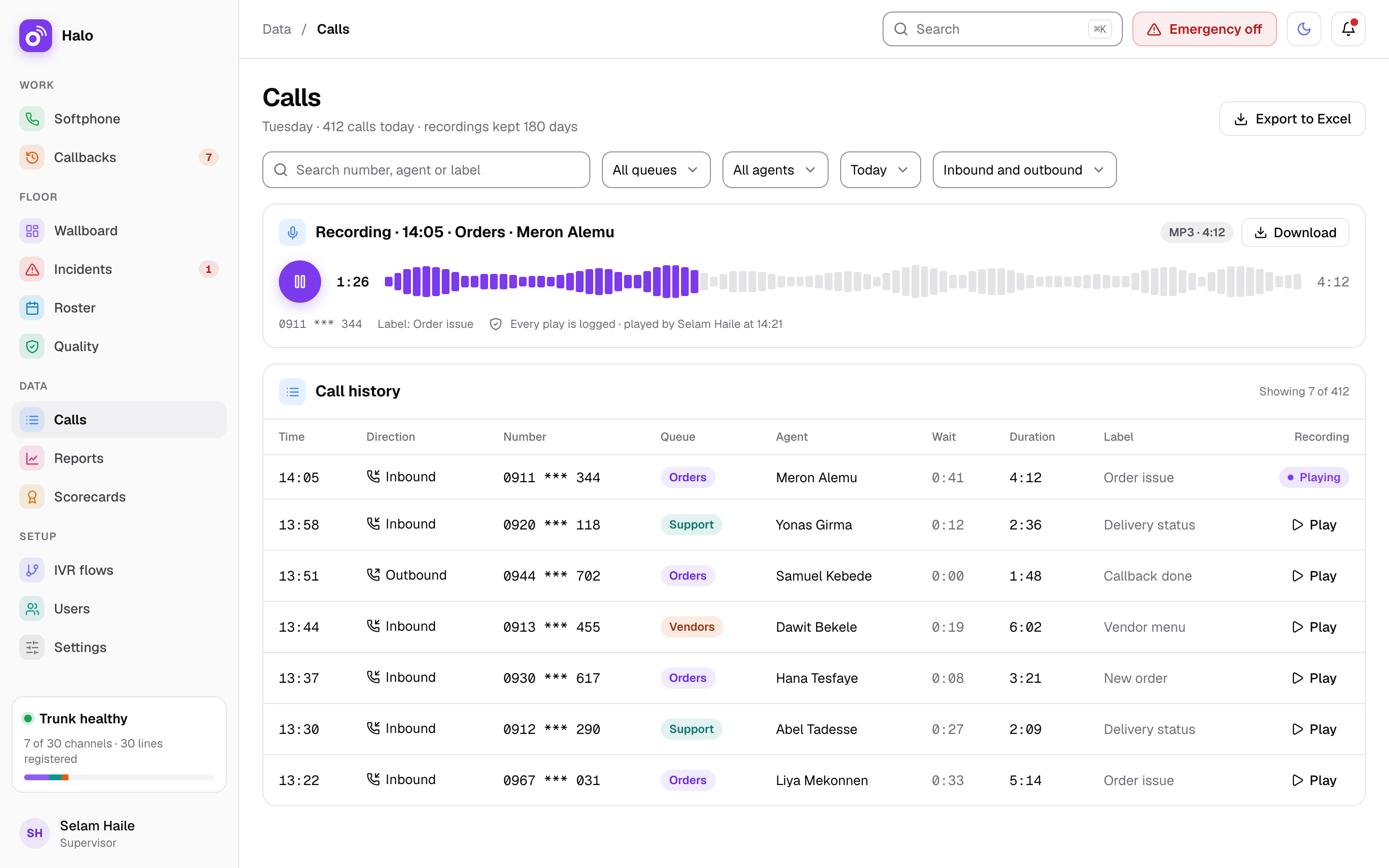
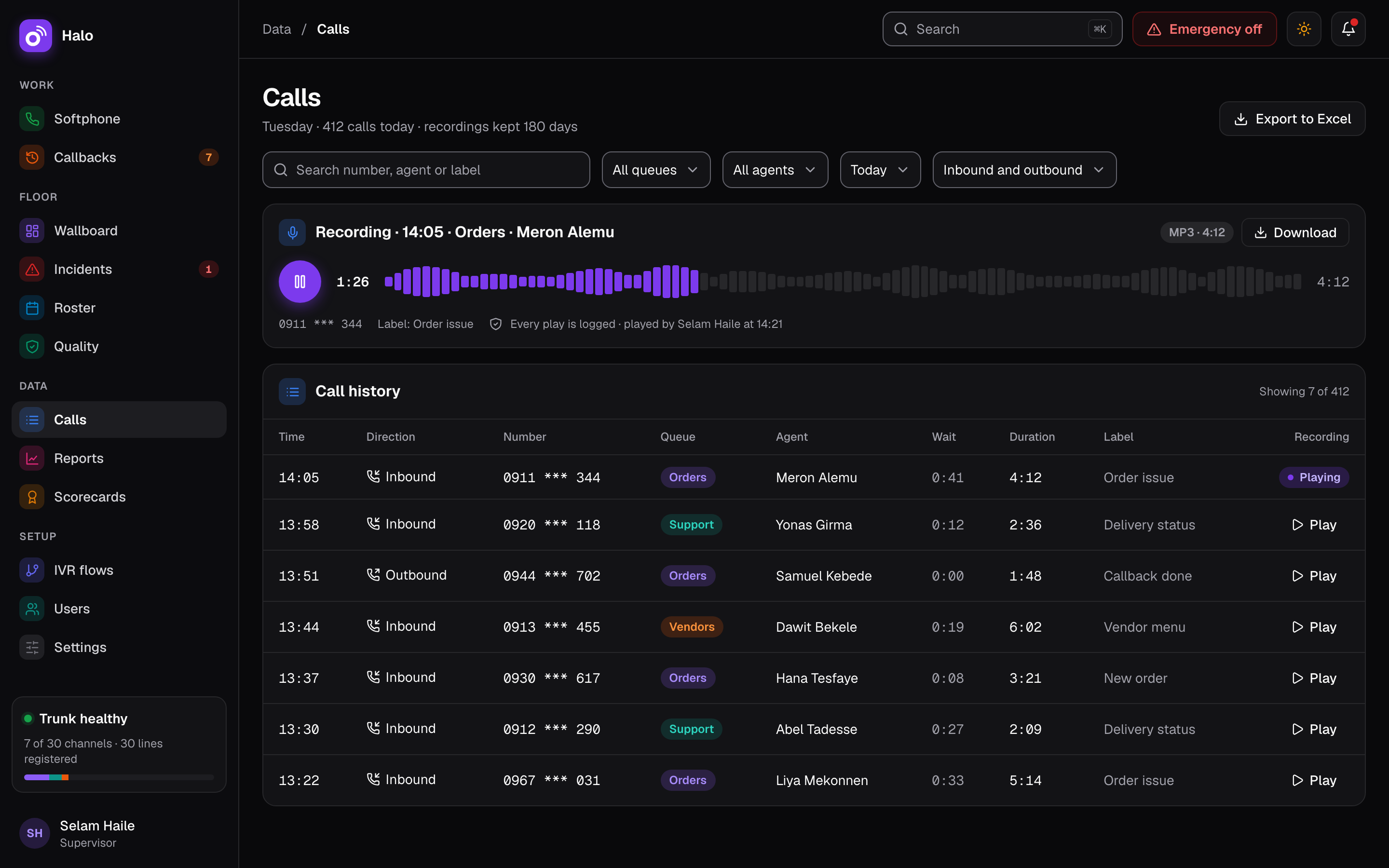
When a customer disputes what was said, you need the recording. You also need to know who listened to it and when.
Card and branch hotline peaks
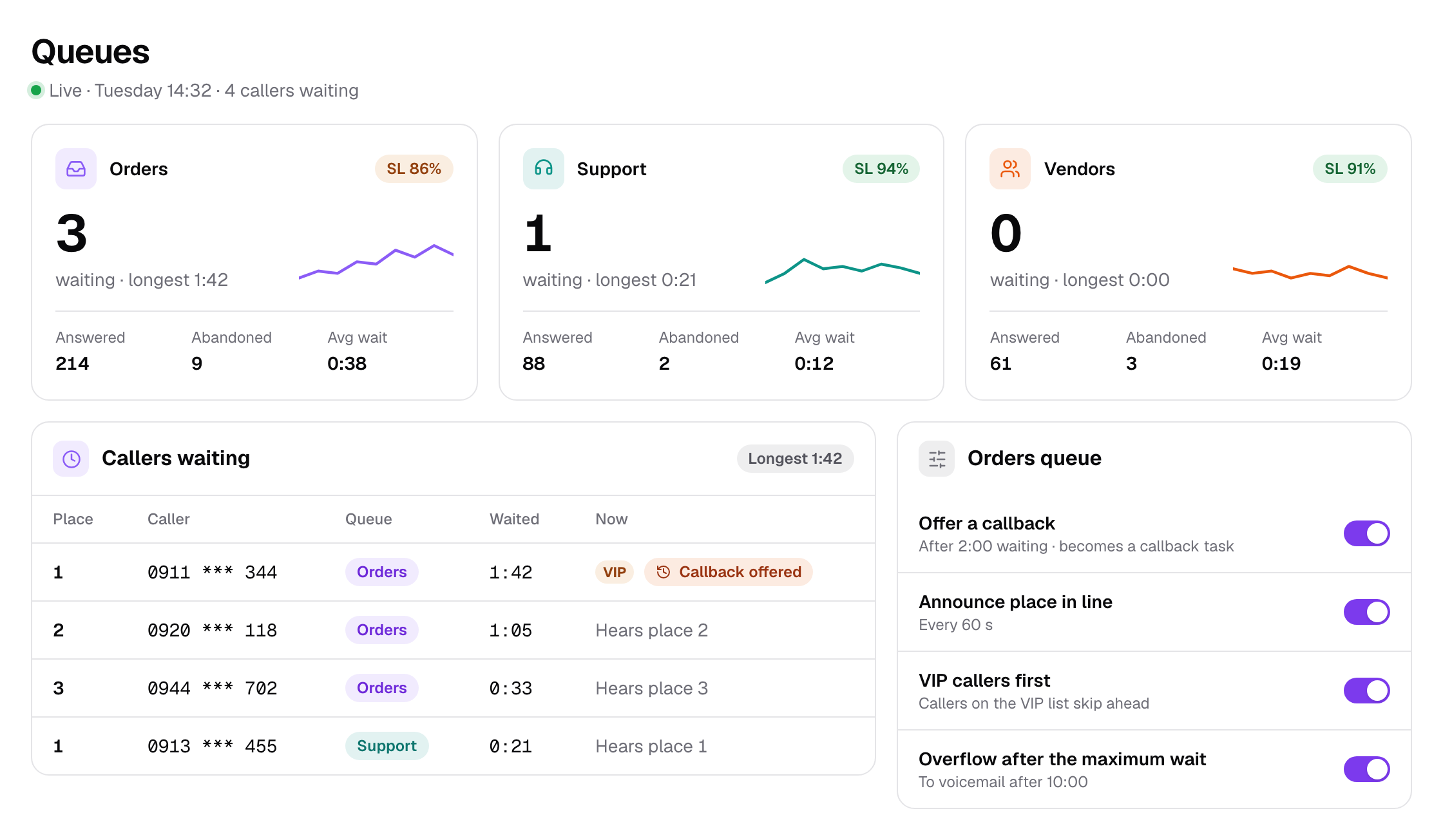
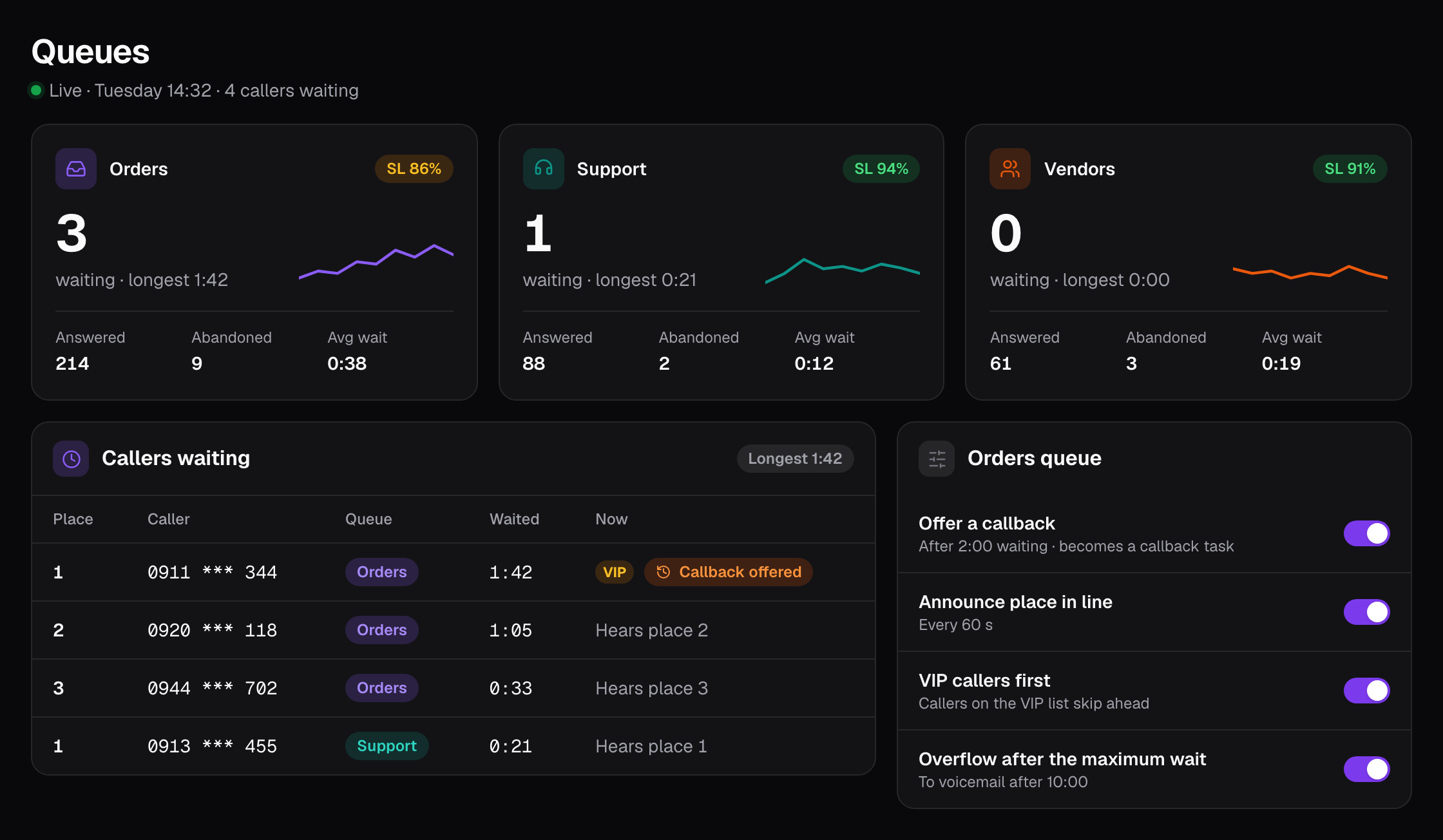
A card problem or a busy branch day can bring many calls at once. Callers need to reach the right team without a long search through the menu.
Call center software for banks
How Halo answers them
Calls and history on your own server
Halo runs on a server for your institution alone, yours or one from Skynet. Calls, recordings and history are kept on it, and Telegram alerts show masked numbers only.
On-premiseEvery agent call recorded
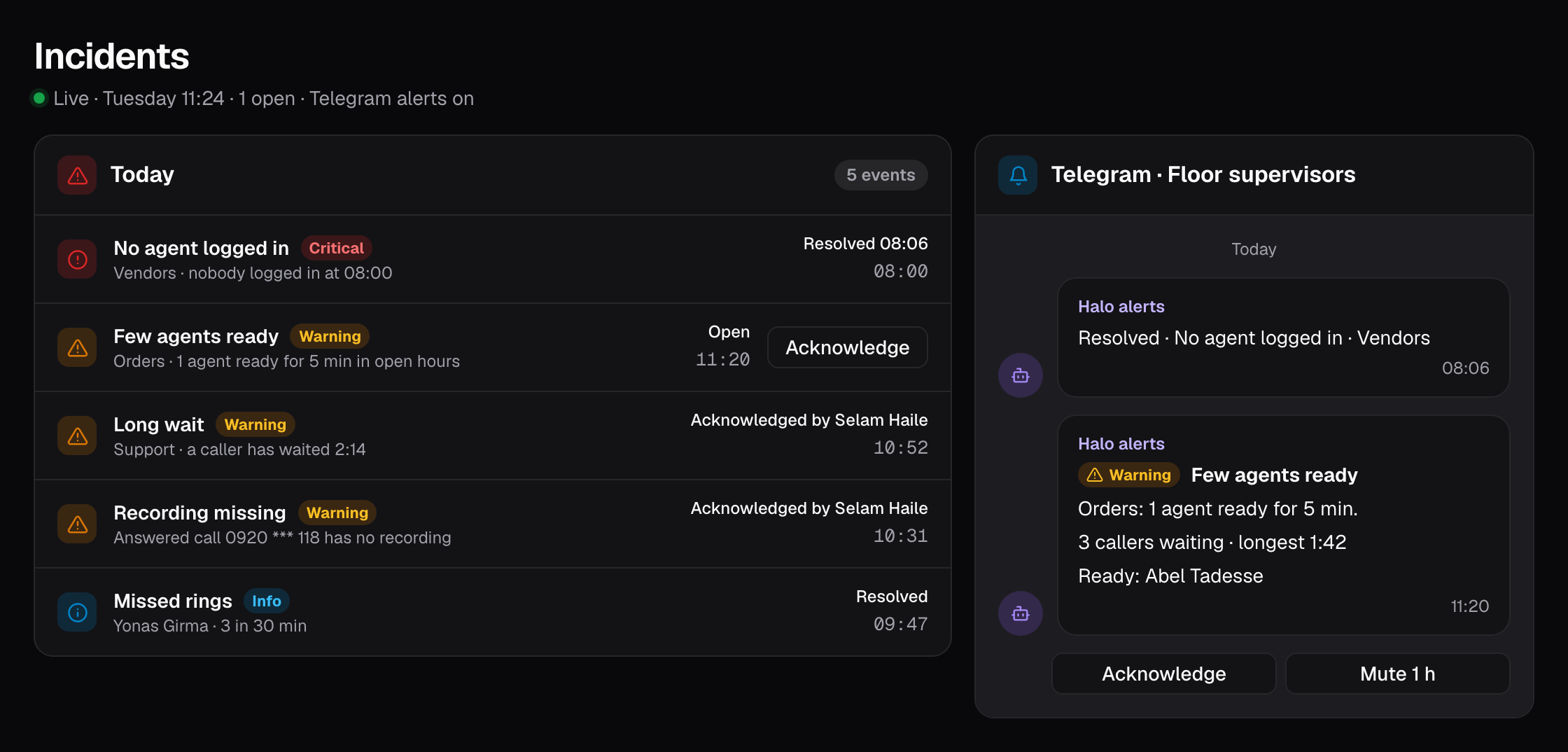
Agent calls are recorded by default and kept for the number of days you set. An alert fires when an answered call has no recording.
Call recording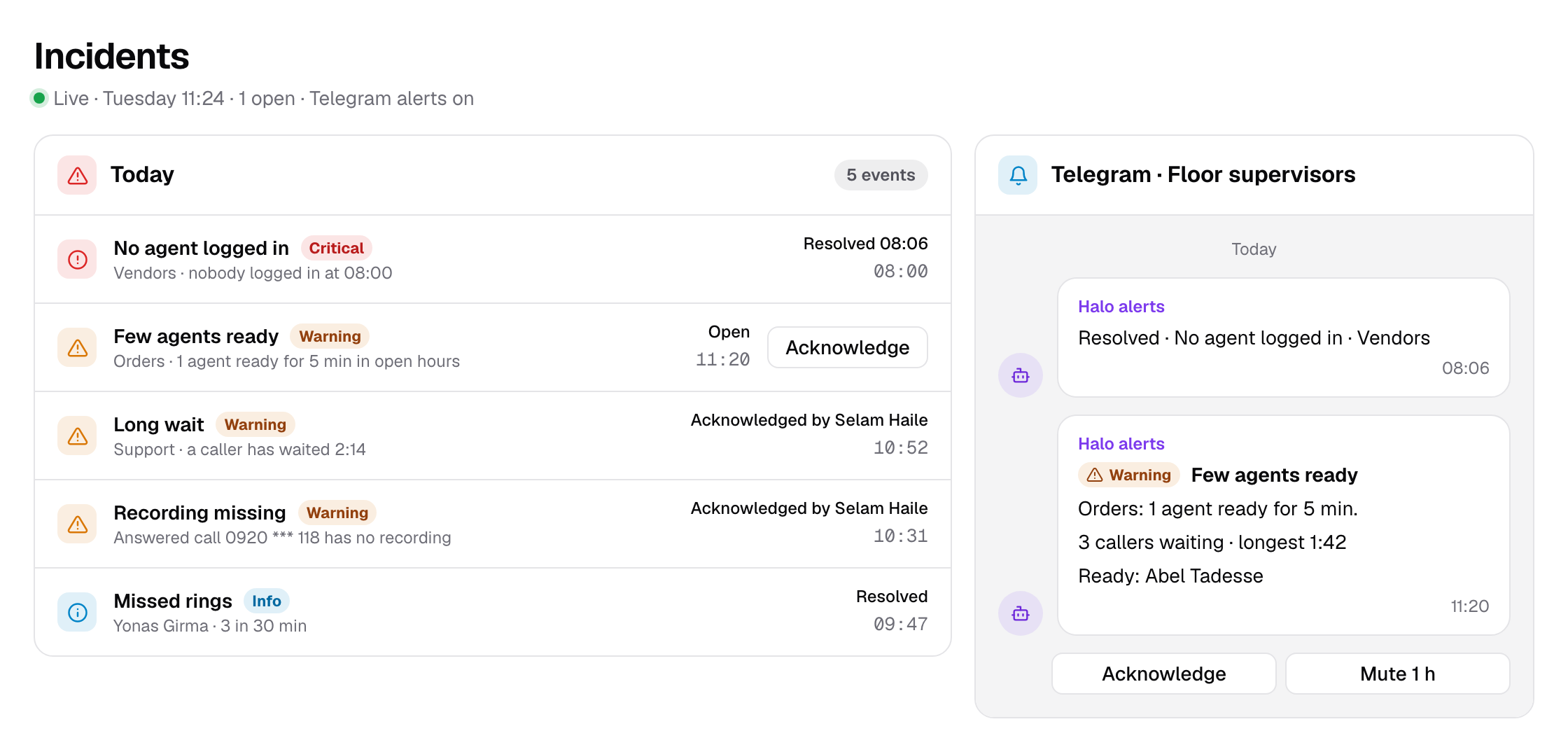
Encrypted backups in Ethiopia
Encrypted nightly backups go to a second server in Ethiopia. They are append-only, and the database restore is tested automatically every week. Security and data
Only the right people listen
Recordings can be played and downloaded only by the roles allowed to, and every play is logged.
Accounts that are hard to misuse
Two-step login for admins and phone users, account lock after repeated wrong passwords, international calls blocked by default and a full audit log.
A voice menu for hotline peaks
Your admin builds the menu from steps such as play, menu, time check, queue and callback offer. Changes are drafted, published and rolled back in one click. Voice menus
A sample day
A Monday on the card hotline
At 08:30 calls about cards rise on the “Support” queue. Samuel Kebede, the admin, publishes a voice menu change that puts the card option first. If it causes trouble, one click rolls it back.
At 09:15 an agent account locks after repeated wrong passwords. Samuel checks the audit log before he does anything else.
At 10:00 Abel Tadesse, the supervisor, listens in on a call taken by a new agent, Yonas Girma, and whispers a short answer to a question about card limits. The caller’s call goes on without a break.
At 11:00 Hana Tesfaye calls to dispute a transfer she discussed by phone last week. Liya Mekonnen, who is allowed to play recordings, finds the call by search and plays it. Her play is logged.
At 15:00 Selam Haile places an outbound call to a customer abroad. International calls are blocked by default, so the call does not go through.
That night the day’s calls and recordings are backed up, encrypted, to a second server in Ethiopia.
What to look for in call center software for banks
Look for software that keeps calls, recordings and history under your control, records every agent call, and shows who listened to what. Questions worth asking any supplier:
- Where are calls, recordings and call history kept, and who controls that server?
- Where do backups go, are they encrypted, and does anyone test a restore?
- Is every agent call recorded, and what happens when one is not?
- Who can play or download a recording, and is each play logged?
- How are accounts protected: two-step login, lockouts, limits on outbound and international calls?
- Can you change the voice menu quickly during a card or branch problem, and undo the change?
- Who installs the system in Ethiopia, and who supports it?
The sections above show how Halo answers each of these.
Skynet VISP
How Halo is set up for banks and microfinance
Skynet VISP installs Halo for you and supports it after go-live. Setup covers four things.
- A server for your institution.Your own server or one from Skynet, for your institution alone. It starts at 4 vCPU, 8 GB RAM and a 500 GB SSD on Debian 13, and Skynet sizes larger teams.
- Your SIP line and backups.The Ethio Telecom SIP line connected and tested over a private link, and encrypted nightly backups to a second server in Ethiopia.
- Your first menu and queues.The first voice menu, your queues, users and hours.
- Training and support.Hands-on training in Addis Ababa. The yearly licence includes updates and support Mon-Sat 08:00-18:00 by phone, Telegram and email.
Facts
- Where calls, recordings and history live
- A server for your institution alone, yours or one from Skynet
- Backups
- Encrypted, nightly and append-only, to a second server in Ethiopia
- Restore test
- Weekly and automatic, for the database
- Recording
- Agent calls by default, as MP3, kept for the days you set
- Who can play recordings
- Only the roles allowed to; every play is logged
- Login
- Two-step for admins and phone users
- Audit
- A full audit log
- International calls
- Blocked by default
- Supervisor tools
- Listen, whisper and barge
Questions from banks and microfinance
Does Halo keep our call data in Ethiopia?
Halo helps you keep call data in Ethiopia. It runs on a server for your institution alone, yours or one from Skynet, and calls, recordings and history are kept on that server. Encrypted nightly backups go to a second server in Ethiopia. Telegram alerts show masked numbers only.
Who can listen to recorded calls?
Only the roles you allow. Recordings can be played and downloaded only by those roles, and every play is logged. Supervisors can also listen to live calls, whisper to the agent or barge in, which helps them coach new agents on the card hotline.
Can agents call numbers abroad?
Not by default. International calls are blocked by default, and daily outbound call caps limit how many calls each person can place. Admins and phone users sign in with two-step login, accounts lock after repeated wrong passwords, and there is a full audit log.
How long are recordings and call history kept?
Recordings are kept for the number of days you set. If the disk reaches 95%, the oldest recordings are deleted with a critical alert, never those from the last 7 days. Call history is kept in Halo’s own database on your server, and v1 does not delete call records automatically.