Government hotline system for public offices in Ethiopia
Public hotlines get many calls at once, from callers who expect to hear Amharic. Halo is a government hotline system that plays voice menus you record in Amharic and runs on a server for your office alone.
Public offices
Three call problems public offices know
Public hotlines with peaks
A new service or an announcement can bring a wave of calls in one morning. Supervisors need to see the wave as it builds.
Amharic voice menus
Most callers expect to hear Amharic first. The menu has to be clear, and it has to change when the office's services change.
Data kept on the office's own servers
Calls from citizens carry personal details. The office wants calls, recordings and history on servers it controls.
Government hotline system
How Halo answers them
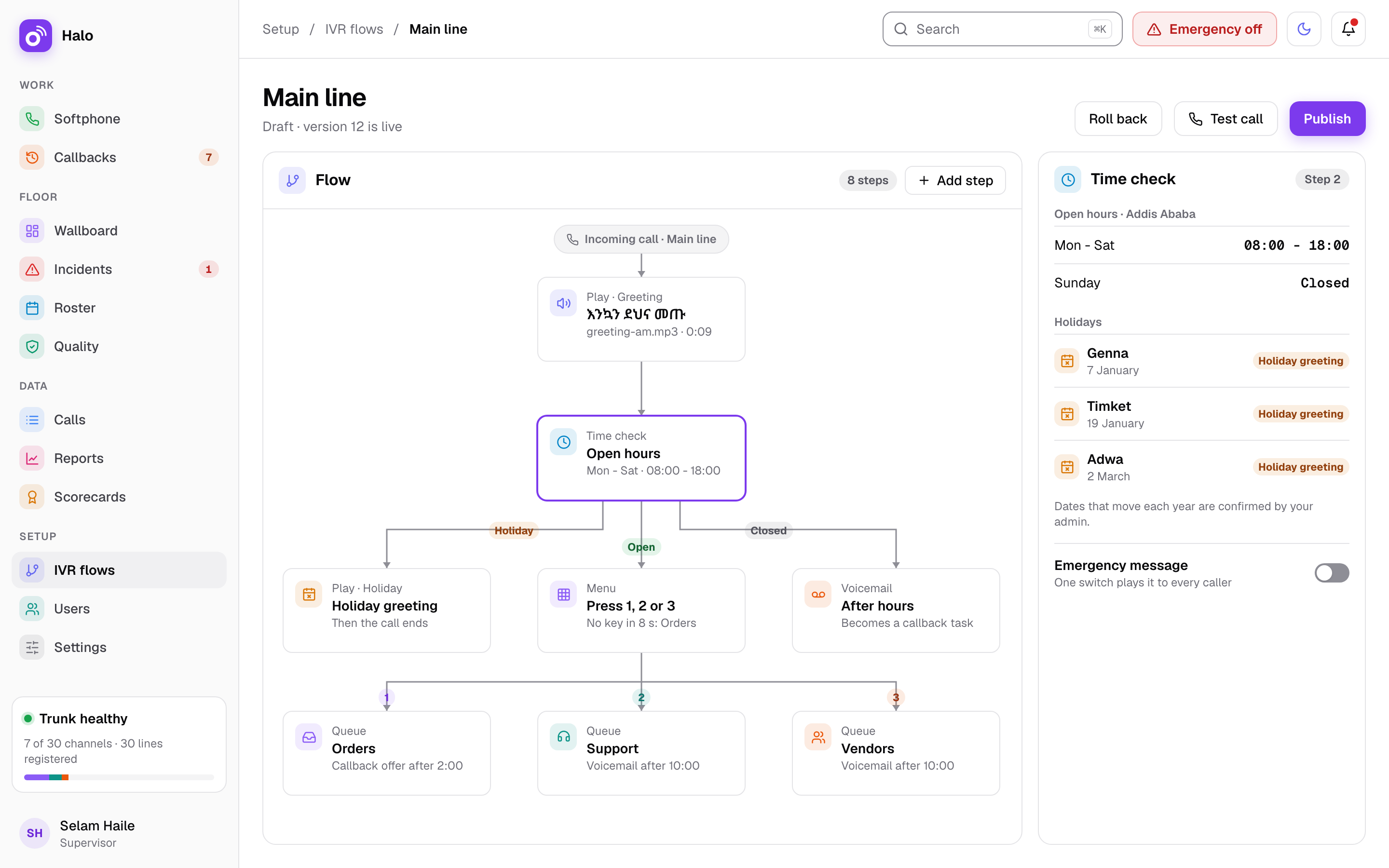
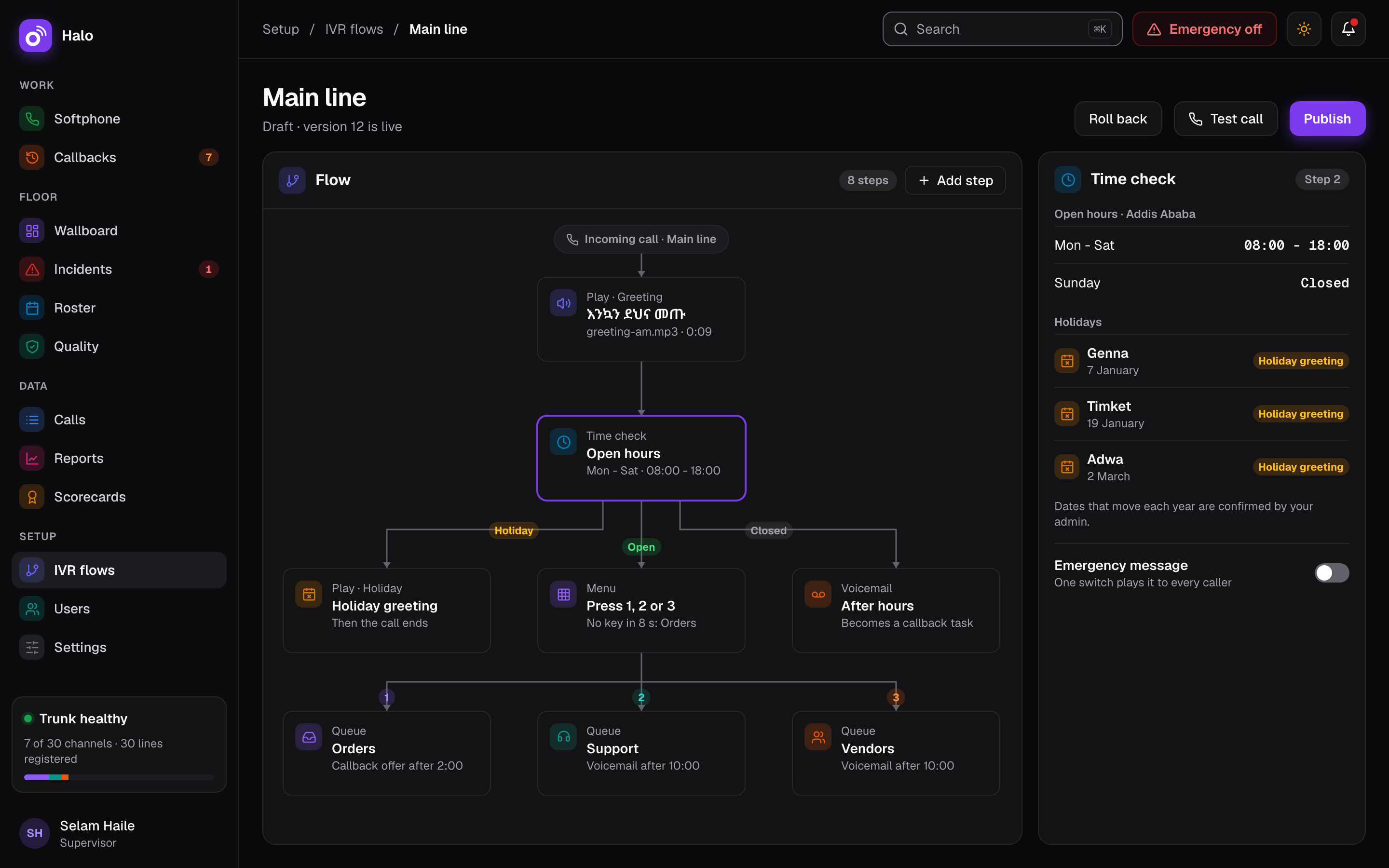
A voice menu your team builds
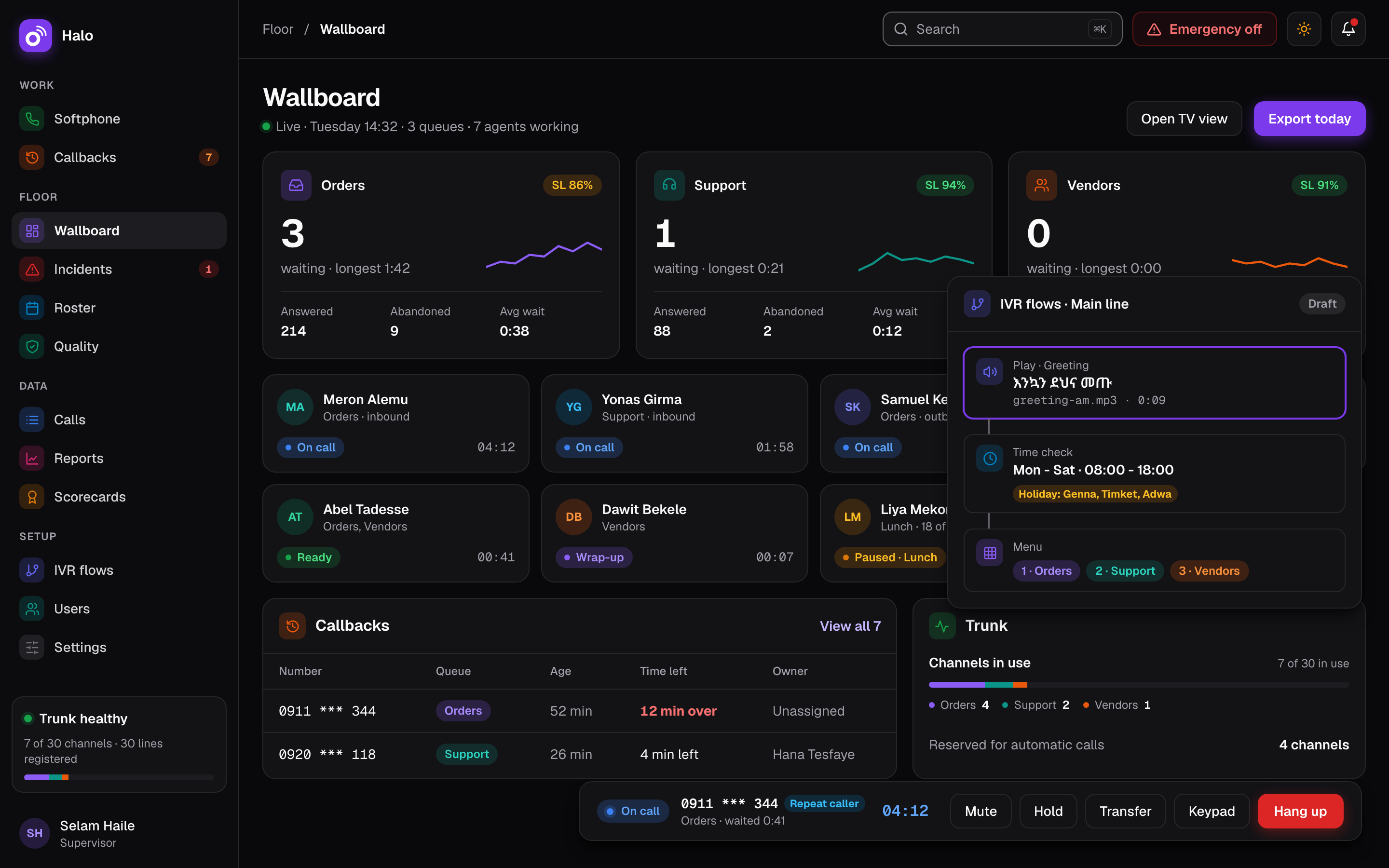
Build the menu from play, menu, time check, queue, transfer, callback offer and voicemail steps. Draft a change, publish it, and roll it back in one click.
Voice menusSee the peak as it builds
The wallboard shows callers waiting, the longest wait, service level and one card per agent. TV mode opens by a link that can be revoked.
Live wallboard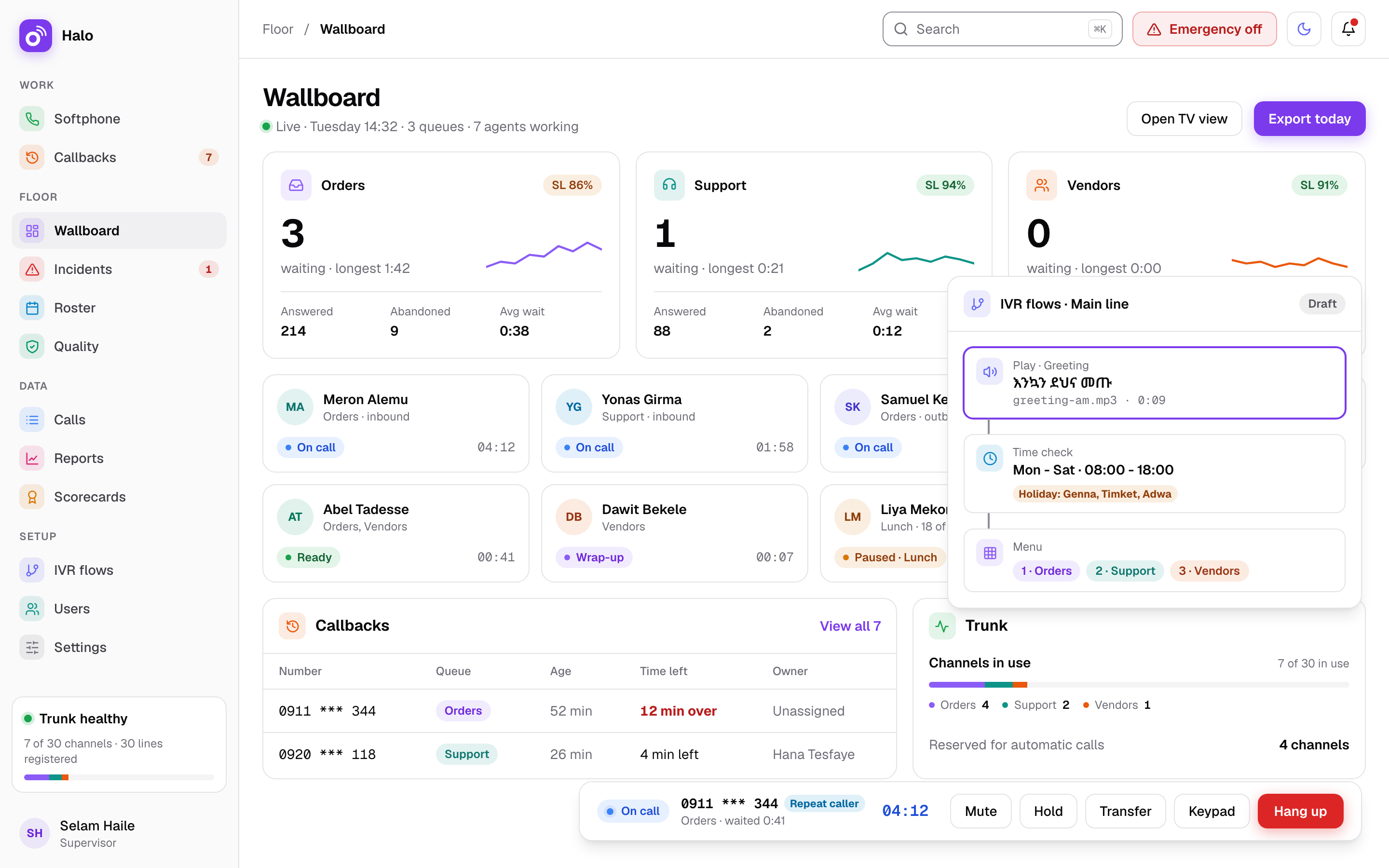
Prompts in Amharic, in your own voice
Voice prompts are your own recordings, in Amharic or any language. Upload MP3, WAV, OGG or M4A files of up to 20 MB and 10 minutes.
Data on your office's server
Halo runs on a server for your office alone. Calls, recordings and history are kept on it, with encrypted nightly backups on a second server in Ethiopia. On-premise
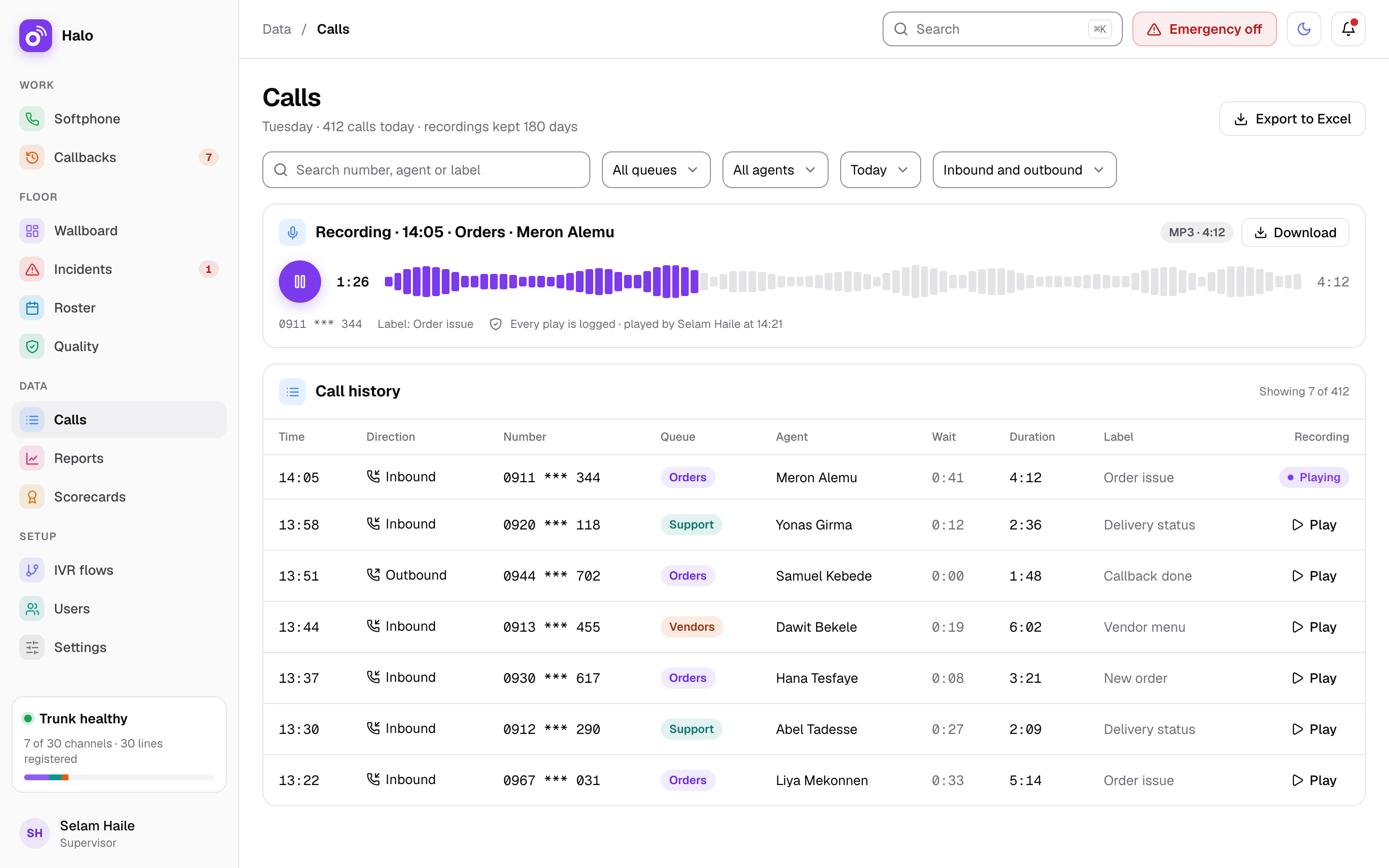
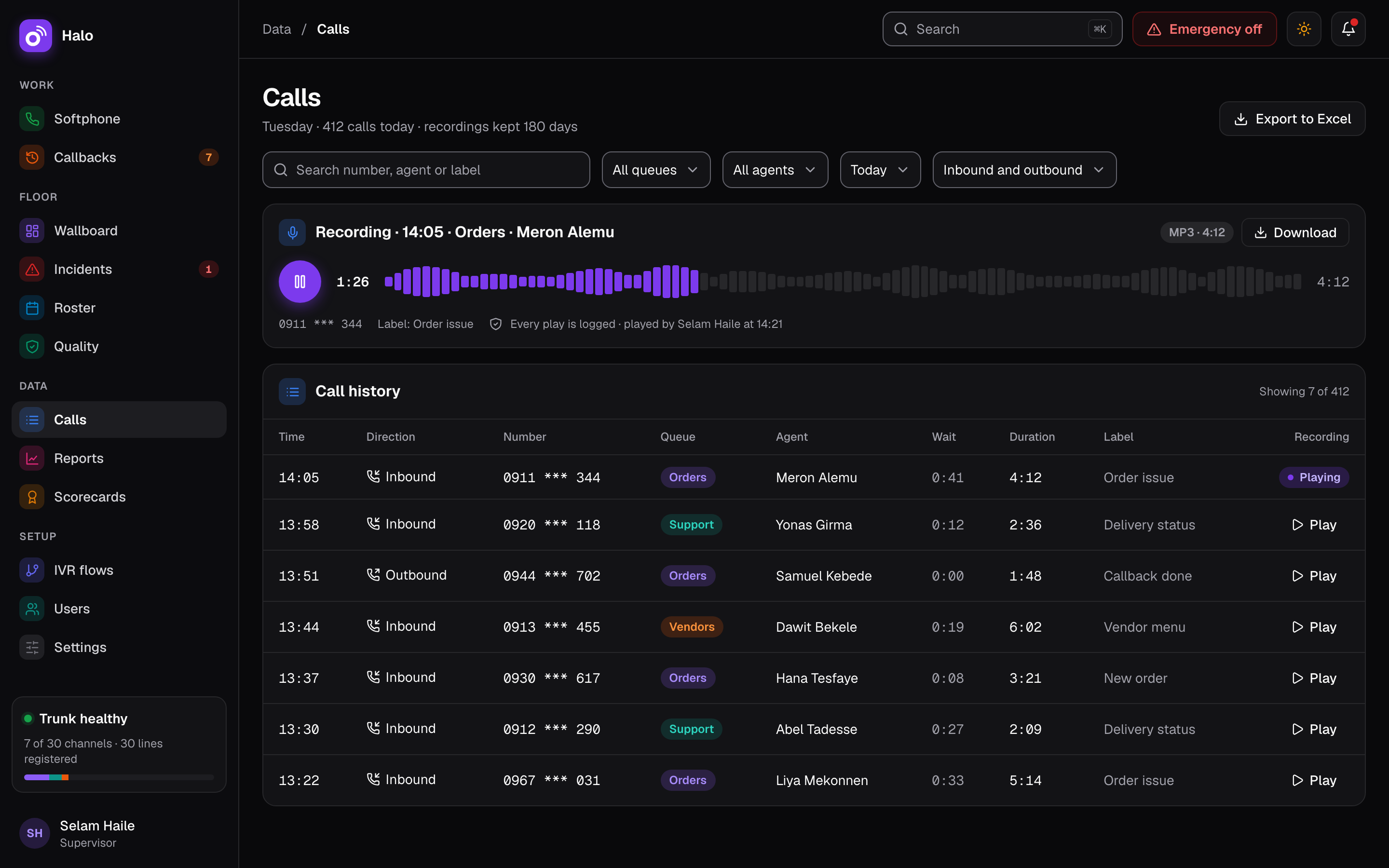
Every agent call recorded
Agent calls are recorded by default, searchable and kept for the number of days you set. Every play is logged. Call recording
A sample day
The morning after an announcement
At 08:30 Samuel Kebede, the supervisor, opens the wallboard on the TV in the supervisors’ room through its TV mode link. The “Support” queue is quiet.
At 09:00 calls to the hotline rise after a public announcement. Samuel sees 14 callers waiting and the service level falling. Each waiting caller hears their place in line, in the Amharic recordings the office made.
Meron Alemu, the admin, records a short Amharic message that answers the most common question. At 09:20 she adds it as a play step before the queue and publishes the change. Many callers now hear the answer before they reach an agent.
At 10:30 Samuel listens in on a new agent, Abel Tadesse, and whispers the answer to a hard question.
Dawit Bekele calls in with a complaint about the service. Selam Haile answers, and the call is recorded and kept on the office’s own server.
At 17:00 Samuel exports the day’s queue and voice-menu drop-off reports to Excel for the head of the office. After hours, the time check in the voice menu sends evening callers to the after-hours message.
What to look for in a government hotline system
Look for a hotline system your own staff can run: menus they record and change themselves, a live view of the queue, and call data on servers the office controls. Questions worth asking any supplier:
- Can your staff record the voice menu in Amharic and change it without waiting for a supplier?
- Can a change be undone at once if it goes wrong?
- Can you send one message to every caller when something urgent happens?
- Where are calls, recordings and history kept, and who controls that server?
- Can supervisors see the queue live, on a screen the whole room can see?
- Are calls recorded, and who can play the recordings?
- Who installs the system in Ethiopia, and does the support team speak Amharic?
The sections above show how Halo answers each of these.
Skynet VISP
How Halo is set up for public offices
Skynet VISP installs Halo for you and supports it after go-live. Setup covers four things.
- A server for your office.Your own server or one from Skynet, for your office alone. It starts at 4 vCPU, 8 GB RAM and a 500 GB SSD on Debian 13, and Skynet sizes larger teams.
- Your Ethio Telecom SIP line.Connected and tested over a private link from Ethio Telecom during setup.
- Your first menu and queues.The first voice menu with your own Amharic recordings, your queues, users and hours.
- Training and support.Hands-on training in Addis Ababa, and support Mon-Sat 08:00-18:00 by phone, Telegram and email, in English and Amharic.
Facts
- Voice menu steps
- Play, menu, time check, queue, transfer, callback offer, VIP and block check, voicemail
- Menu changes
- Draft, publish and one-click rollback
- Prompts
- Your own recordings, in Amharic or any language
- Prompt files
- MP3, WAV, OGG or M4A, up to 20 MB and 10 minutes
- Where data lives
- A server for your office alone, with encrypted nightly backups on a second server in Ethiopia
- Wallboard
- Callers waiting, longest wait, service level, one card per agent
- Recording
- Agent calls by default, kept for the days you set
Questions from public offices
Can our staff record the voice menu in Amharic?
Yes. Voice prompts are your own recordings, in Amharic or any language, uploaded as MP3, WAV, OGG or M4A files of up to 20 MB and 10 minutes. Your admin builds the menu in the voice-menu builder, drafts a change, publishes it, and can roll it back in one click.
Can we play an urgent message to every caller?
Yes. Halo has a one-switch emergency message for days when every caller must hear the same news first. For a smaller change, your admin can add a play step with a new recording before the queue and publish it, as in the sample day above.
Does hotline data stay on our own server?
Halo helps you keep call data in Ethiopia. It runs on a server for your office alone, and calls, recordings and history are kept on it. Encrypted nightly backups go to a second server in Ethiopia. Call history is kept in Halo’s own database, and v1 does not delete call records automatically.
Can the wallboard run on a TV in the office?
Yes. TV mode opens the wallboard by a link that can be revoked, so you can show it on a screen in the supervisors’ room and switch it off later. It shows callers waiting, the longest wait, service level and one card per agent, and changes show within 2 seconds.